AKA The Holy Trinity: first course, second course and dessert.
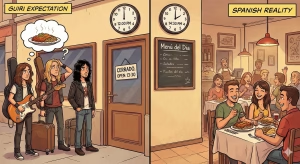
If the previous lesson was about when to eat, this one is about what to order to keep the band budget from collapsing. In Spain, lunch is not just a meal; it is a legally protected institution known as the “Menú del Día”. Forget generic sandwiches or expensive à la carte dishes. When you walk into a humble restaurant between 13:30 and 15:30, you are entering a sanctuary of caloric efficiency that has no rival in the rest of Europe.
To understand why this exists, we have to look back at history. This isn’t just a quirky tradition; it was actually a law. In the 1960s, during the tourism boom, the government implemented a “Tourist Menu” mandate requiring all restaurants to offer a complete meal at a fixed, affordable price. Originally designed to feed the influx of tourists and the local workforce without breaking the bank, the name evolved, but the concept remained sacred. It is a culinary right of the people, and now, it is your lifeline on the road.
Here is how it works: for a fixed price (usually between €12 and €15), you don’t get one plate. You get a “Primer Plato” (usually vegetables, soup, or pasta/rice), a “Segundo Plato” (meat or fish with garnish), bread, dessert (or coffee), and a drink. And yes, in many roadside places, that drink can be an entire bottle of wine per person. It is a massive amount of food designed to fuel a construction worker for the rest of the day, so it will definitely fuel a drummer.
Now, here is the most important linguistic warning of your tour. In English, when you sit down, you ask for “the menu” to see the list of food. Do not do this in Spain. If you ask for “La Carta,” they will give you the list of expensive, individual dishes. If you try to translate “Dish of the day” by asking for “Lo del día,” the waiter might interpret it as the “Chef’s Special,” which is often a premium item not included in the cheap deal.
The magic word you must use is simply “Menú”. Just that. “Tenéis Menú?” (Do you have a Menu?). In Spanish, Carta is the book with all the options, and Menú specifically means the three-course fixed-price deal. If you say “Carta,” you pay €30. If you say “Menú,” you pay €12 for the same amount of food. Learn the difference, respect the history, and gorge yourselves at 14:00… because you probably won’t eat again until after the show.